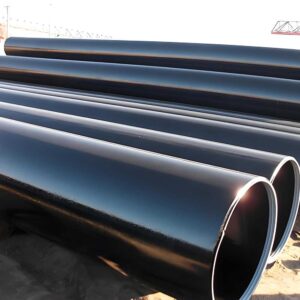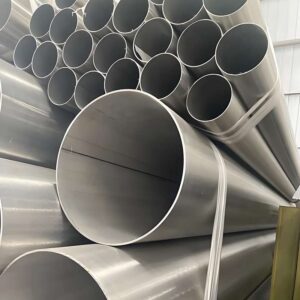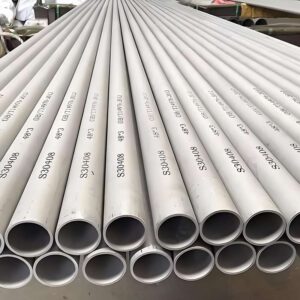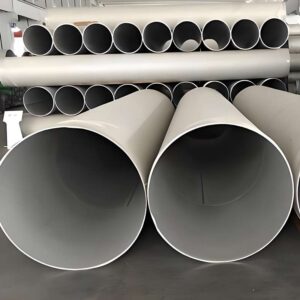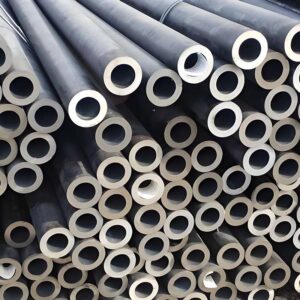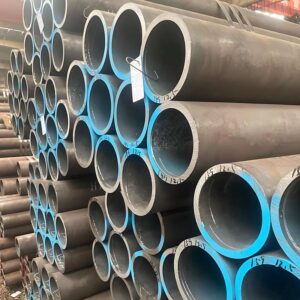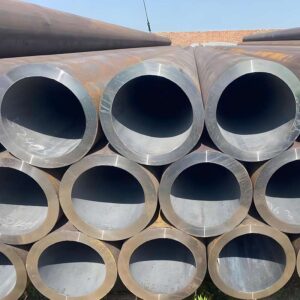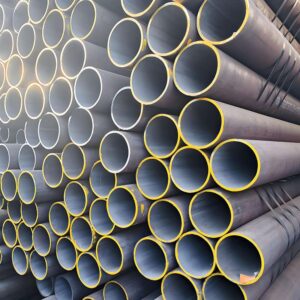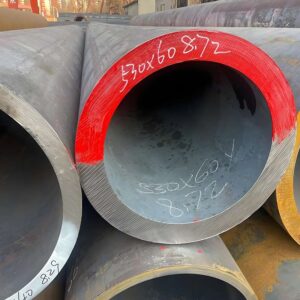
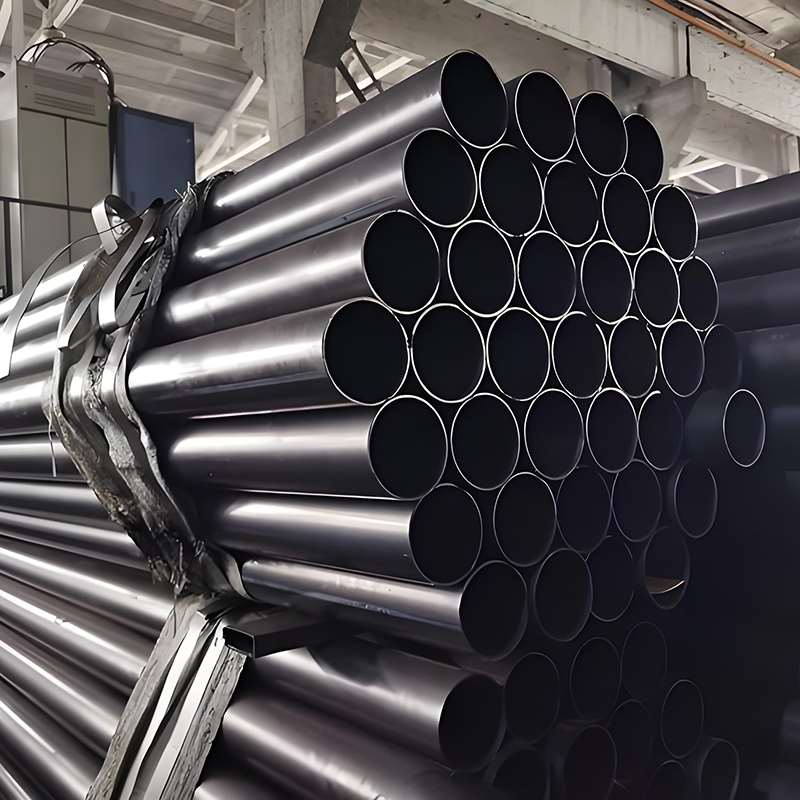
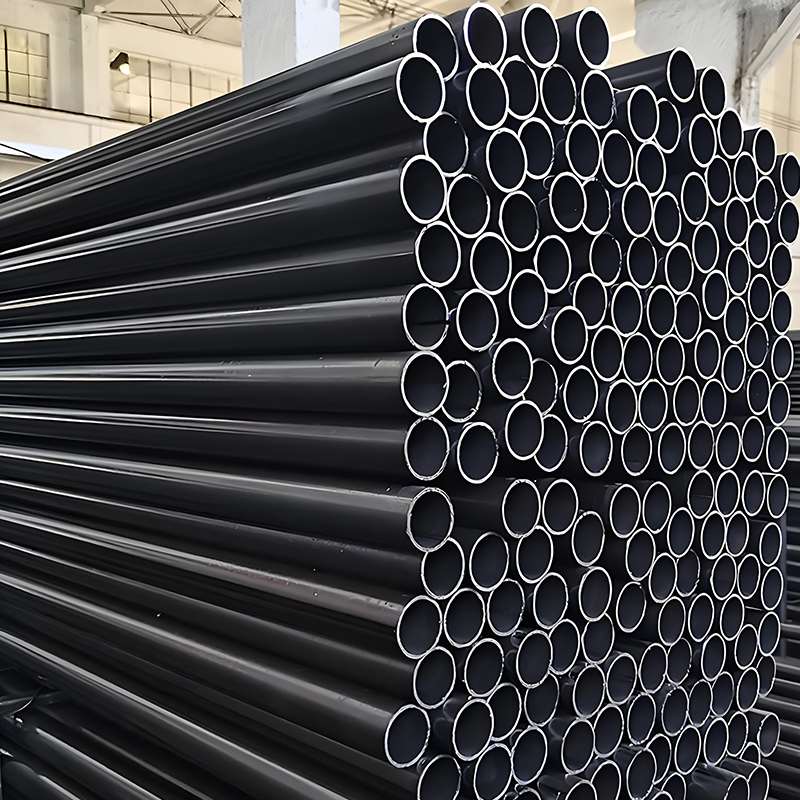
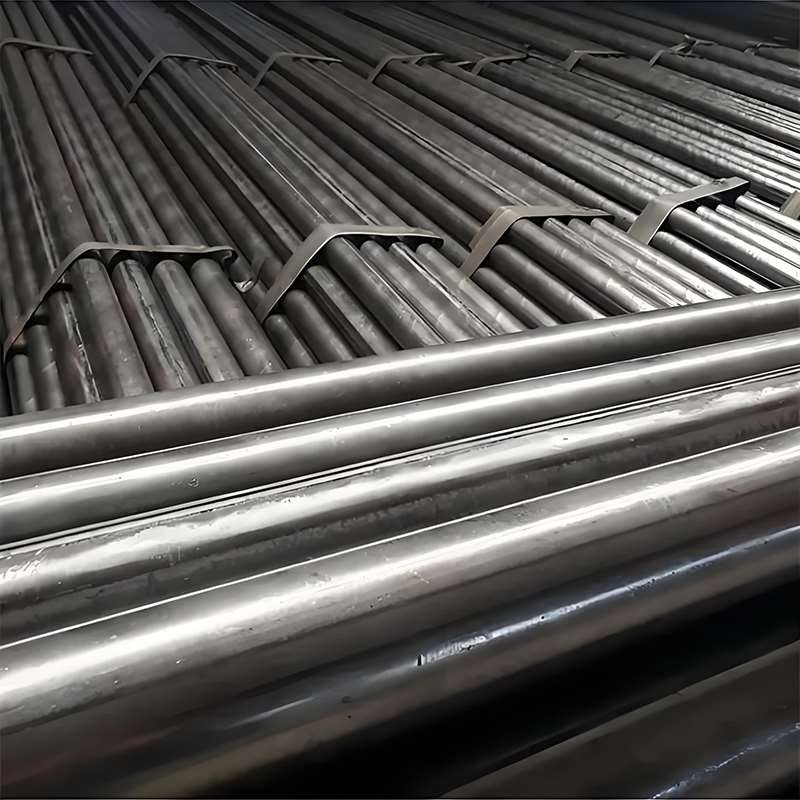
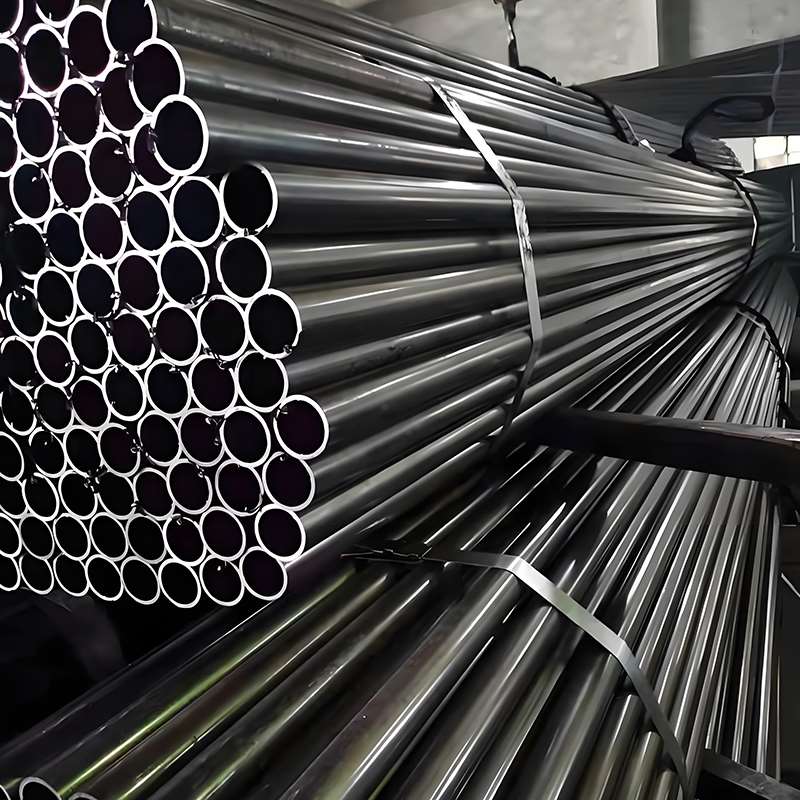
Black welded steel pipe is a seam steel pipe made of steel plate or steel strip, which is formed by rolling and welding. Its surface is not galvanized, so it presents the original color of black metal. It is commonly known as “black iron pipe” or “black pipe” in the industry.
I. Black Welded Steel Pipe Production Process
Raw Material Preparation → Forming → Welding → Weld Seam Treatment → Heat Treatment and Sizing → Inspection → Finished Product Processing
| Process | Main Contents |
|---|---|
| Raw-material preparation | Inspect steel strip/plate, level, and remove surface impurities. |
| Forming | Progressively bend the strip through rolls to form round or square tube blanks. |
| Welding | High-frequency electric-resistance welding (ERW) or submerged-arc welding (SAW) to produce straight-seam or spiral pipe. |
| Weld treatment | Clean and grind both internal and external welds to ensure smooth, defect-free seams. |
| Heat treatment & sizing | Heat-treat the weld zone to relieve stresses; size and straighten to achieve dimensional accuracy. |
| Testing & inspection | Hydrostatic test, ultrasonic or eddy-current NDT, plus visual and dimensional checks. |
| Finishing | Cut to length (common lengths 6 m, 12 m); end finishing (bevel or plain); apply rust-proof coating or leave in black condition. |
II. Implementation standards for black welded steel pipes
| Standard System | Standard No. | Title (English) | Scope of Application |
|---|---|---|---|
| China GB | GB/T 3091 | Welded steel pipes for low-pressure liquid delivery | Tap water, gas, heating and other low-pressure fluid services |
| GB/T 13793 | Longitudinal electric-resistance-welded steel tubes | General structures and fluid conveyance with straight-seam pipe | |
| GB/T 9711 | Steel pipe for petroleum and natural-gas industries | Oil & gas transmission lines requiring higher pressure ratings | |
| SY/T 5037 | Spiral submerged-arc welded steel pipe | General fluid service using spiral welded pipe | |
| SY/T 5040 | Submerged-arc welded steel pipe | Spiral welded pipe for oil & gas transmission | |
| ASTM (USA) | ASTM A53 | Pipe, steel, black and hot-dipped, zinc-coated, welded and seamless | Water, gas, steam and mechanical structural uses |
| ASTM A252 | Welded and seamless steel pipe piles | Foundation piling works | |
| ASTM A500 | Cold-formed welded and seamless carbon steel structural tubing | Building and mechanical structures | |
| EN (Europe) | EN 10217 | Welded steel tubes for pressure purposes | Pressure service, e.g. boilers, pressure vessels |
| EN 10219 | Cold-formed welded structural hollow sections of non-alloy and fine grain steels | Construction and mechanical structures | |
| API | API 5L | Line pipe for pipeline transportation systems | Oil & natural-gas transmission pipelines |
III. Performance characteristics of black welded steel pipe
i. Strength and pressure bearing capacity
Using low carbon steel or low alloy steel as raw material, the weld strength can reach the level of the parent material.
Suitable for medium and low pressure fluid transportation and structural support.
ii. Weldability and Processability
Materials are primarily Q235, Q345, and other materials, offering excellent weldability.
Threaded, beveled, and flanged connections are available to meet diverse installation requirements.
iii. Surface Condition
Ungalvanized, the surface is a natural black metal.
Secondary anti-corrosion treatments such as painting, oiling, 3PE coating, and epoxy powder coating are available upon request.
iv. Corrosion Resistance
Bare pipes have average corrosion resistance and require an anti-corrosion coating for long-term outdoor or underground use.
They maintain a long service life in a dry environment at room temperature.
v. Flexible sizes and specifications
A wide range of outer diameters is available (typically DN15 to DN2000 and above).
Wall thickness can be customized to meet standard or customer requirements.
vi. Service life
Significantly affected by the operating environment.
Without corrosion protection, the service life is generally 5–10 years. With an anti-corrosion coating, this can be extended to 20–50 years.
vii. Cost Advantages
Compared to seamless steel pipe, it is more affordable and suitable for large-volume projects.
It offers high production efficiency and short delivery cycles.
IV. Things to note when purchasing black welded steel pipe
i. Determine the application and choose the right standard.
Water supply, drainage, and heating pipes → Choose GB/T 3091 or ASTM A53
Petroleum and natural gas transportation → Choose GB/T 9711 or API 5L
Building structures → Choose GB/T 13793 or ASTM A500
ii. Check the material
Commonly used steel materials are Q235 and Q345.
For projects requiring high strength, choose Q345, which is more pressure-resistant than Q235.
iii. Consider the wall thickness and outer diameter
The greater the pressure, the thicker the wall.
It must meet design requirements; don’t just focus on cost.
iv. Pay attention to weld quality
Welds should be uniform, crack-free, and free of pores.
You can request ultrasonic or hydrostatic testing reports from the manufacturer.
v. Consider anti-corrosion treatment
Indoor use → Black pipe is sufficient.
Outdoor or buried → Coating (such as anti-rust paint, epoxy, or 3PE) is recommended.
vi. Check the manufacturer's qualifications
Is it ISO certified?
Can it provide third-party testing reports?
v. Transportation and Storage
Protective packaging is required for long-distance transportation.
V. Frequently Asked Questions about Black Welded Steel Pipe
i. Will black welded steel pipes corrode or rust?
Answer:
Yes, black welded steel pipes are prone to rust in humid or acidic or alkaline environments, especially when exposed outdoors or in contact with water or chemical liquids.
Protective measures:
For outdoor environments, they can be hot-dip galvanized or painted with anti-rust paint; Avoid prolonged water contact with the pipe surface; Regularly check and clean surface rust.
ii. Are welds prone to leaks or cracks?
Answer:
The weld is the weakest link in welded pipes. If the weld quality is substandard or if the pipe is subjected to prolonged pressure shock, microcracks or leaks may occur.
Recommendations:
Select a qualified manufacturer to ensure uniform and smooth welds;
Perform weld flaw detection before installation;
Avoid exceeding the design pressure during use.
iii. Are pipes prone to deformation or bending?
Answer:
During transportation, handling, or construction, black welded steel pipes may bend or partially deform due to uneven stress.
Preventative Measures:
Use supports or skids during transportation and stacking to avoid excessive stacking.
Use lifting equipment during construction to avoid hard dragging or pulling.
Select appropriate wall thickness to increase the pipe’s bending resistance.
iv. Will black welded steel pipes become clogged?
Answer:
Long-term transport of slurry, water, or granular media within pipes can easily lead to sedimentation and scaling, reducing flow capacity.
Solution:
Regularly clean the interior of the pipes;
Filter the media being transported or install a sedimentation device;
Plastic-lined or coated pipes can be used for special media.
v. Will the service life of black welded steel pipe be shortened?
Answer:
Service life is affected by many factors, such as ambient humidity, corrosive media, pressure fluctuations, and construction and installation quality.
Suggestions for extending service life:
Select appropriate wall thickness and material grade;
Apply anti-corrosion treatment (painting, galvanizing, or anti-corrosion coating);
Periodic maintenance and inspection, and timely treatment of rust or damage.